Polishing improves reflection, not form
PolishMaster treats polishing as a reflection decision on a surface that already reads as even under revealing light. Ridges, hollows, and coating faults are form and preparation problems. Adding a polishing product cannot level what is still uneven, and it cannot rescue a coating that failed underneath.
If the goal is still to control geometry or to build a coherent base for color and sheen, the path belongs earlier in finishing — see How to Make 3D Prints Smooth. Sheen choice and how light will read the finished part are covered in Matte vs Glossy Finish.
Is the surface ready to polish?
Readiness is visible, not assumed. Before polishing enters the plan, confirm what the surface shows:
- Layer lines and other repeating ridges no longer dominate the faces that will be judged by reflection.
- Low spots that side light still catches have been addressed as form problems, not left for polishing to hide.
- Any coating under the polishable surface is compatible, fully cured as its label requires, and free of soft or failing areas.
- The surface is clean — dust, oils, and residue will mark reflection before they mark anything else.
- Intentional edges still read crisply; polishing is not being asked to restore detail that preparation already lost.
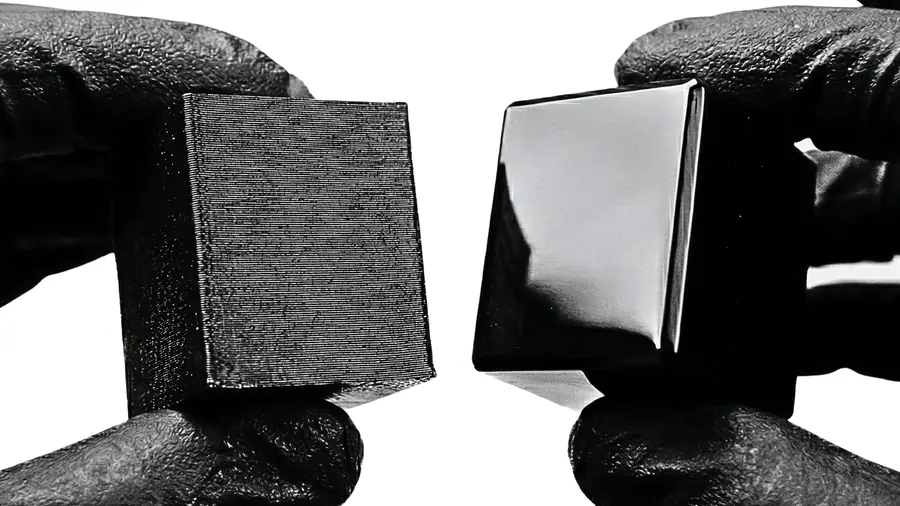
The contrast is the lesson: reflection quality belongs on a surface that already supports it. A glossy look in a photo is not itself proof that polishing is the next correct step.
Compatibility, cure, and cleanliness come first
Product compatibility, full cure, and a clean surface matter more than adding another product. Filament blends and coating systems differ; a combination that works on one spare print may not behave the same on the next. Follow each manufacturer's guidance for use, cure, and safety. Do not assume that unrelated products will stack safely.
Incomplete cure leaves a soft or unstable base. Contaminants create haze, streaks, and uneven reflection. Those conditions are decision stops — resolve them before polishing is asked to improve what it cannot repair.
A small test area beats another product
A controlled test area on a spare print or a hidden face reveals how the surface and coating respond before the visible faces are committed. The question is observation: does reflection improve without soft edges, new haze, or coating damage? If the response is unclear or harmful, stop. Adding another product does not replace that check.
When polishing is the wrong next step
- Repeating ridges or low spots still dominate under side light.
- The coating underneath is uncured, incompatible, or already failing.
- Contamination is still present on the surface.
- Edges have already gone soft and polishing would only advertise the loss.
- The intended finish does not need high reflection — see the sheen decision in Matte vs Glossy Finish.
Bottom line
Polish when reflection quality is the remaining job and the surface underneath already supports it. PolishMaster connects that choice to a visible standard: even form, compatible cured coatings, cleanliness, and a small test area — not another product added in hope.