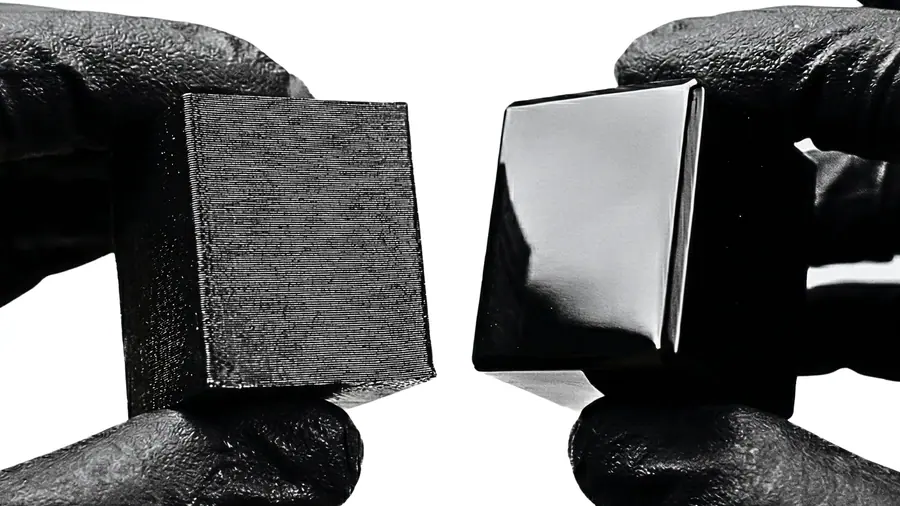
Which plastics does acetone act on?
Acetone softens the surface of ABS, which is why vapour smoothing is talked about for that material. It does not dissolve PLA or PETG in a useful way. On those two it does not give a controlled, even surface, and it can damage the part.
Why this page gives no solvent how-to
Acetone is highly flammable, and its vapour is a fire and inhalation hazard. Vapour smoothing of ABS needs real precautions: ventilation, no ignition sources, suitable protective equipment, and following the label and the safety data sheet. A short blog section cannot cover that responsibly, so it is not attempted here.
What to do on PLA and PETG
For PLA and PETG the route is mechanical: sand in stages, then polish. The surface changes because material is removed in controlled steps, not because a chemical melts it. That also keeps edges and fine detail in your hands, where a solvent can soften them along with the layer lines.
Where to read next:
- The whole route in one place:How to Make 3D Prints Smooth
- PETG heats up and gums differently:How to Sand PETG 3D Prints
- Why water helps in the later stages:Wet Sanding 3D Prints: When and How
- Once the surface is even:When to Polish a 3D Print
This isn’t a shortcut
This isn't a shortcut. You'll still sand. The mechanical route takes time and patience, and how a part comes out depends on the print, the plastic and your hands. Try it on a spare part first.
And ABS?
ABS is the one material in this list where solvent smoothing exists. PolishMaster’s method does not use solvents, and ABS is finished the same mechanical way as PLA and PETG. If you choose vapour smoothing on your own, treat it as a separate, hazardous process and follow the label and the safety data sheet.
What PolishMaster’s method does not cover
THE FORMULA covers FDM prints in PLA, PLA+, PETG and ABS. Silk, TPU and filled filaments are outside the method.
Bottom line
Acetone is an ABS question with a hazard attached, not a shortcut for PLA or PETG. For PLA, PETG and ABS alike, the route PolishMaster teaches is mechanical: sand in stages, then polish, on bare plastic.